Here is what I propose, and what I’ve put in one place so far (moqui-framework/README.md):
LLMs are considered tools used by people. The person using the tool is just as responsible as with a text editor and keyboard. LLMs are the functional and moral equivalent of a hammer: they do not shake themselves, and are not a substitute or replacement for a responsible party.
Don’t trust, verify. Use AI to help verify, but remember who is responsible, and who is a who.
Let me know if anything is sufficiently incorrect or unreasonable to warrant a change. Sooner or later, I propose we adopt this across all Moqui Ecosystem.
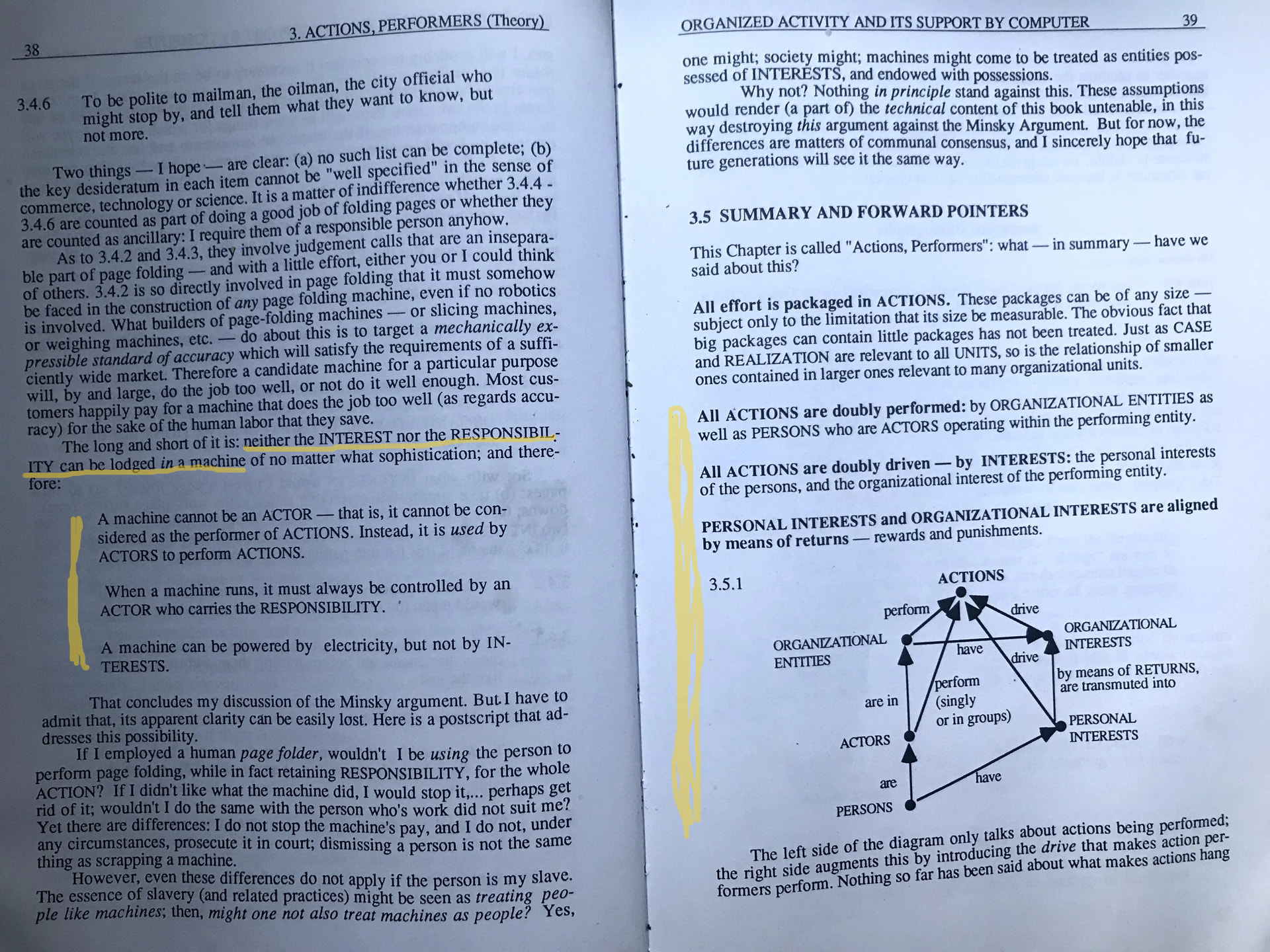
David’s comment above about “who is responsible, and who is a who”, brought to mind the discussion below, a page of which I’ve scanned in. Perhaps it may be of some use when it comes to considering aspects like assigning tasks to LLMs in Hivemind etc.
It’s taken from a 1997 book by the computer scientist Anatol Holt called “Organised Activity and its Support by Computers”. I don’t think the overall proposition presented in the book is worth presenting, but just this extract, towards provoking thought.
The discussion is around the argument put forward by such thinkers as Marvin Minsky, that technologists are creating a better, smarter, more enduring class of actors than man; whereas Holt, mirroring David, insists that a person who accepts a job takes responsibility for doing the work, a machine does not.
Some of the terminology it uses for concepts differs from Silverstone’s, but I think the concepts themselves might be familiar. Anyway I thought it might provide some food for thought towards this thread.
As of right now, the concepts are holding, but the lines are getting blurry and I cannot confidently say this will always be the case. Anyway, even verification nowadays is being done with more agents, as it is very hard to keep up.
Mr-moqui for example is exceeding 1.5 million lines of code made in weeks. No human can keep up, you can test at a higher level, and even at a higher level you can only test so much before your eyes get blurry. So you need to set agents on top of other agents to sweep the codebase, test everything, and report results. How to thoroughly verify all that testing is another pickle.
So the practice is changing, and although the concept of “responsiblity” exists, the concept of “verify” might be a little harder to get right.
Yeah, with the new mr-* repos the question of AI usage and system quality comes to the foreground.
Overall, in many ways, I’m already more confident in MR Moqui than in Moqui Java… but I am expected certain types of rough edges having gone through all this with Moqui Java. There are likely to be things that run fine in a test and bug out on real data, and likely to be little quirks here and there that bring things crashing down until it’s all stabilized and vetted.
Like you say @taher , business systems were already so complicated that evaluating them was a big effort and yet mostly deferred with name/etc-based trust, but even in the last couple years before LLMs were useful for writing complex systems they were already useful for analyzing and evaluating complex systems. My guess is, that will increasingly be the norm… a sort of massive in-sourcing of software evaluation using AI assistance.
For MR Moqui and the other mr-* components, my theory is that certain categories of bugs/issues are actually better found and fixed by LLMs than by humans (by far with some of the latest)… BUT, other types of bugs and issues need human eyes. We need lots of human eyes, that’s the main thing I don’t already have a solution for other than to hope that the legacy of OFBiz and Moqui will attract enough people to give it a try, and complain because at first it is super-cool, and then reality starts settling in, so people will naturally complain, and then we find out about the bugs or dumb designs or whatever.
Until a better strategy comes along, that’s the one I’ve got for now…